
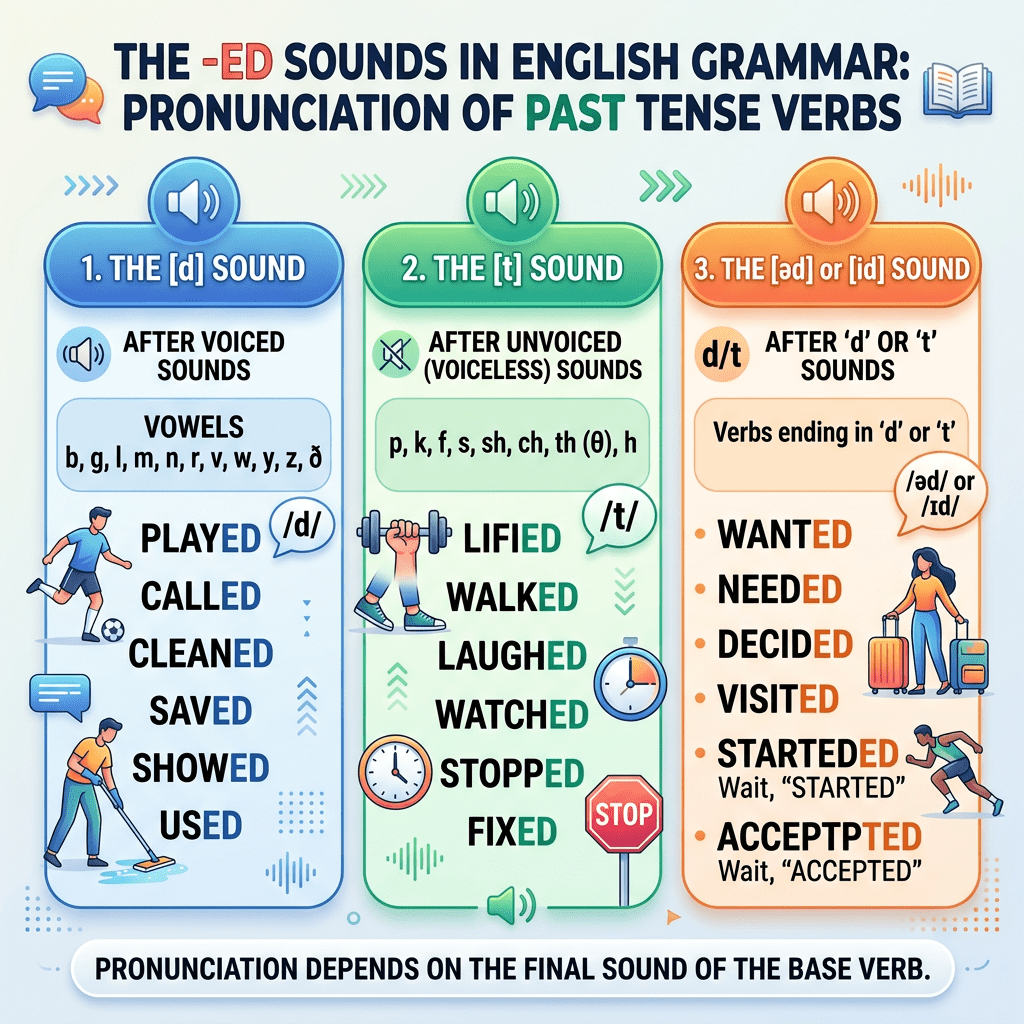
Regular past verbs are usually formed by adding “-ed” to the base form. However, they are often pronounced incorrectly, which can confuse language learners and even native speakers.
For example, the verb “played” should be pronounced with a clear “d” sound, but some people mistakenly say it as “play-ed.” This mispronunciation can make it hard for listeners to understand the meaning.
Below are the “-ed” sounds you may find useful to pronounce in the correct way.
Contents
(1) -ed as /-t/ sound
In the past verb (regular), -ed sounds like /-t/ (ធ) Voiceless sound when verb ends with – p – k – s – ch – sh – f – x – h before -ed.
Ex: stop – stopped; pick – picked; fix – fixed
(2) -ed as /-d/ sound
In the past verb (regular), -ed sounds like /-d/ (ឌ) Voiceless sound when verb ends with – l – v – n – m – r – b – v – g – w – y – z – and vowel sounds.
Ex: love – loved; can – canned, play – played
(3) -ed as /-id/ sound
Verbs that end with -t or -d with -ed will sounds like /-id/ (អ៊ីត).
Ex: print – printed, hand – handed






 Rotana K., English